
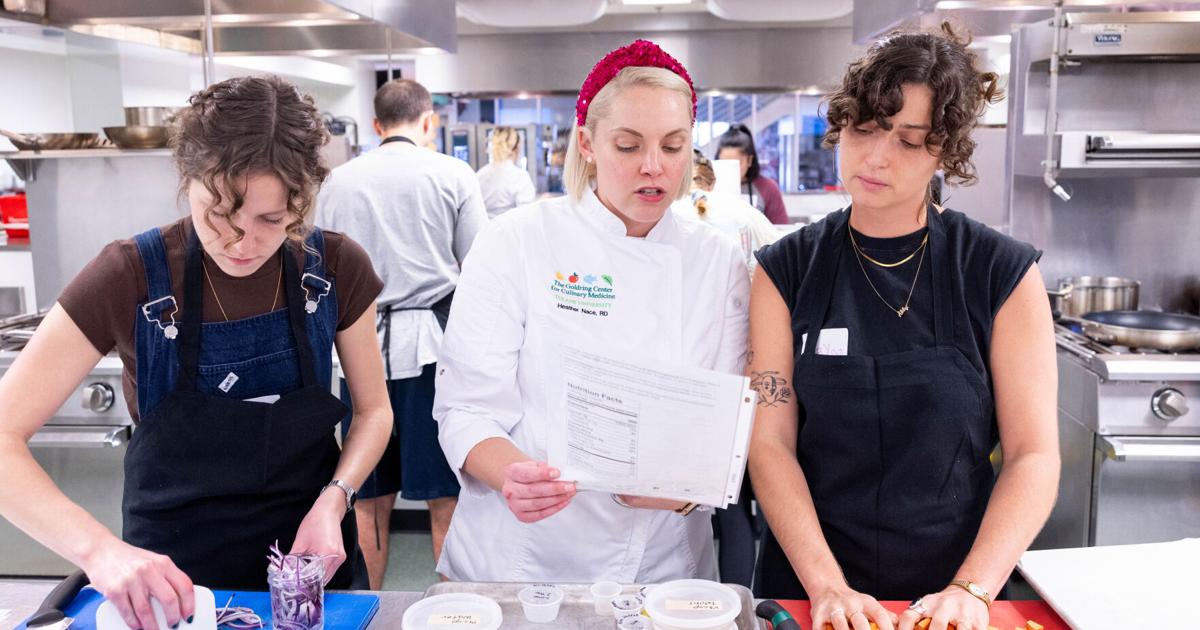
Leaning over a stainless steel bowl, chef Heather Nace urged a fourth-year medical student to massage her kale with greater gusto.
“You gotta get in there, girl,” Nace said, explaining that massaging breaks down cellulose so the leaves become tender and palatable. “If you don’t massage it, it’s not going to digest.”
At Tulane University’s Goldring Center for Culinary Medicine, founded in 2012 as the first teaching kitchen embedded in a U.S. medical school, moments like this are the curriculum. Medical students rotate between case studies and cooking stations, translating nutrition theory into meals they can cook themselves and, one day, recommend to patients.
The center also runs free community cooking classes, giving New Orleanians the same chance to build skills and confidence in the kitchen.

Medical students at the Goldring Center for Culinary Medicine dig into the food they cooked after going over case studies. (Photo by Sabree Hill via Tulane University)
Case studies and cooking
On a recent Friday, students were given several patient scenarios: a 29-year-old woman with lactose intolerance who still needed adequate calcium, a 38-year-old with suspected celiac disease and a preschooler with a nut allergy.
The exercise asked them not only to counsel the patient medically, ordering tests to diagnose and treat their conditions, but also to build meals that would work with their lifestyles.
At another station, second-year medical student Mashaal Syed meticulously chopped an onion for a Mediterranean-style salad. She hopes to go into neurosurgery, a field not often associated with nutrition counseling. But Syed sees an opportunity.
“Just because you do surgery doesn’t mean you want everyone to receive surgery,” Syed said. “If I can help someone manage symptoms through diet — like a patient with Parkinson’s — that’s a win.”
She added that credibility matters. Patients are bombarded with online advice, from gluten-free fads to seed-oil scares.
“If you can speak from experience, if you’ve cooked the food yourself, it makes a difference,” Syed said.

Fudgy black bean brownies, one of the recipes cooked by students during a free community cooking class at the Goldring Center for Culinary Medicine in New Orleans, La., Monday, May 20, 2019. Offering beginner, intermediate, family and kids classes, the courses focus on the concepts of nutrition and healthy eating.
Community classes
The center also arms community members to think more critically about the connection between food and health. Since 2013, the program has reached more than 1,600 community members in New Orleans out of their kitchen next to Whole Foods on Broad Street.
Interest remains high: The waitlist now tops 650 people, with 200 added since January alone. Classes are available for children as young as 5.
Shannon May, 24, saw the class information at a farmers market. Curious, she signed up with a couple of friends. Over the six weeks, her approach to food changed.

Allison Clark plates Chewy Banana Nut Oatmeal Cookies in a free community cooking class at the Goldring Center for Culinary Medicine.
“I hated cooking before this,” May said. “I was impatient, I ate out a lot, and I wasted food.”
Goldring’s instructors showed her how to save money by buying sale items like family packs of chicken and turning them into multiple meals, how to store ingredients properly, and how to add fiber-rich foods to ease her chronic stomach pain.
She now cooks more often at home, leans on simple black bean tacos and zucchini muffins, and checks Goldring’s online recipe database for weekly inspiration.
The center also develops specialized classes. In partnership with the Tulane Center for Genetics, staff created courses for families managing phenylketonuria, a rare genetic disorder requiring a nearly protein-free diet.
Other offerings have focused on patients with prediabetes and type 2 diabetes, teaching budget-friendly recipes that keep carbs in check while increasing fiber, protein and healthy fats.
“Our general curriculum and recipes are all based on Mediterranean diet principles, meaning that they can be applied to all our most prevalent chronic conditions of heart disease, diabetes and hypertension,” said Nace, the director of operations and executive chef.

Lynette Thornton, left, and her nephew, Ta Ray Roberts assemble quinoa lettuce wraps in a free community cooking class at the Goldring Center for Culinary Medicine in New Orleans.
Tracking the changes
This fall, one group is also contributing to research. Through the Culinary Health Outcomes Project, adults 55 and older will have lab work done before and after the six-week series. Researchers will track changes in blood sugar, cholesterol, blood pressure and other health markers.
For Kristi August, a 60-year-old who works in law enforcement, the study offered a timely reset. Already, she’s experimenting with new ingredients, paying closer attention to protein, healthy fats, fruits and legumes. She was always interested in cooking, but now she thinks more about how it affects her health.
“I just find myself doing things differently,” August said.
She’s adding more vegetables to tacos, for example. She also has more energy.
This is something that everybody could benefit from,” August said. “If I had done this class when I was 25, my kids probably would eat differently.”
The Goldring curriculum has grown far beyond New Orleans. First developed at Tulane, it now forms the backbone of the American College of Culinary Medicine and is licensed to more than 60 institutions nationwide, including medical schools, residency programs, nursing schools and dietetic programs.
Nace serves on the ACCM advisory board, helping update the curriculum and set standards for other sites.
For Nace, who has led the program for six years, the payoff is the ripple effect: Students taking what they learn into clinics, patients gaining confidence in the kitchen, and families changing daily habits.
The food as medicine concept
Although the “food as medicine” concept is now often touted by politicians pushing the “Make America Healthy Again” movement, the Goldring Center model has remained consistent since its founding: introductory classes in the first year, focused modules on protein, fats, hypertension, and allergies, and electives that give students both counseling skills and culinary skills.
Early sessions include mindfulness and motivational interviewing, teaching future physicians to draw out what patients are ready and willing to change.
“We’re not saying food instead of medicine,” Nace emphasized. “We’re saying food as a complement. There are barriers we can’t solve, like food access, but we can improve kitchen confidence.”
Nace offers the kind of tips you might otherwise find yourself Googling in the frozen meat aisle or searching on YouTube mid-recipe: how to slice an onion efficiently, or how to decide between wild-caught and farmed salmon on a budget.
During a recent class, as the scent of garlic, ginger and onion filled the room, she moved easily from station to station — setting a timer for one student, then pausing to explain the chemical reaction that turns sunflower seed cookies green, a favorite trick for the youngest chefs.
The class builds toward a shared meal. At the end, one-time strangers sit together at a long counter lined with dishes that look ready for a restaurant menu: chana masala with roasted cauliflower, turkey and zucchini sliders with lemony yogurt sauce, a cucumber and avocado salad, roasted salmon, and a kale salad massaged to a dark, glossy sheen.
For a moment, there is silence as the students fill their plates and dig in. Then Nace pulls up the nutrition information for each dish on a screen, linking flavor back to science.
link